If we women are to learn the fundamental things in life, we must
educate ourselves and one another. For instance, why in this land of
great wealth is there great poverty? Any intelligent young woman like
those who write to me, eager to help the sightless or any other
unfortunate class, can learn why such important work as supplying food,
clothing, and shelter is ill-rewarded, why children toil in the mills
while thousands of men cannot get work, why women who do nothing have
thousands of dollars a year to spend ... There is an economic cause for
these things.
It is for the American woman to know why millions
are shut out from the full benefits of such education, art, and science
as the race has thus far achieved ... We must know why 150 of our
sisters were killed in New York in a shirt-waist factory fire the other
day, and nobody to blame ... why our fathers, brothers, and husbands are
killed in mines and railroads.
I am surprised to find that many
champions of woman, upholders of 'advanced ideas,' exalt the
intelligence of the so-called cultivated woman. The woman who works for a
dollar a day has as much right as any other human being to say what the
conditions of her work should be. It is just this, I am sorry to find,
which educated women do not always understand.
Throughout the
ages, man has drilled woman in morals, that she might not deceive him;
he taught her obedience, that she might be his slave. He made her laws,
constituted himself judge, jury, jailer, and executioner. He had entire
charge of her prisons and convents, or her house, her church, and her
person. He burnt her, tortured her, gave her to wild beasts and cast her
forth to be a pariah ... Through all times he granted her the privilege
-- of bearing his children.
A woman opens a can of food which
is adulterated with worthless or dangerous stuff. In a distant city a
man is building himself a palace with the profits of many such cans. If a
petty thief should break into her pantry, and she should fight him
tooth and nail, she would be applauded for her spirit and bravery; but
when a millionaire manufacturer a thousand miles away robs her by the
peaceful methods of commerce, she has nothing to say, because she does
not understand business, and politics is not for her to meddle in.
In the hospital wards where the nurse [works], there are men
unnecessarily laid low by the accidents of trade ... from the
battlefields of industry come the wounded, from the shambles of poverty
come the deformed. What enemy has stricken them? How much of all this
disease and misery is preventable? Shall the wise nurse stand by the bed
of pain and ask no questions about the social causes of ill health?
It has been found that you must feed your child before you can teach
it, and that the poor home defeats the best schoolroom. Behind the free
school we must have a free people. What profits it to provide costly
school buildings for anemic, under-fed children, to pass compulsory
education laws and not secure a livelihood for the families whose
children must obey them? What is the common sense of free text-books
without wholesome food and proper clothing?
Countless mothers of
men have no place fit to be born in, to bear others in, to die in.
Packed in tenements forgot of light, unheeded and slighted, starved of
eye and ear and heart, they wear out their dull existence in monotonous
toil -- all for a crust of bread! They strive and labor, sweat and
produce; they subject their bodies and soul to every risk, lest their
children die for want of food ... [all this] has but served to herd them
in masses under the control of a growing industrial despotism.
Many young women full of devotion and good-will have been engaged in
superficial charities. They have tried to feed the hungry without
knowing the cause of poverty. They have tried to minister to the sick
wihout understanding the cause of disease. They have tried to raise up
fallen sisters without knowing the brutal arm of necessity that struck
them down. We attempt social reforms where we need social
transformations.
The greatest change is coming that has ever
come in the history of the world. Order is evolving out of the chaos
that followed the breaking up of the old system in which each household
lived after its own manner. By using the physical forces of the universe
men have replaced the slow hand-processes with the swift power of
machines. If women demand it, a fair share of the machine-products will
go to them and their families ... They will no more give their best
years to keep bright and fair the homes of others while their own are
neglected. They will no more consume all their time, strength, and
mental capacity in bringing up the rosy, laughing children of others
while their own sweet children grow up pitiful and stunted.... We know
that there is plenty of room in the world and plenty of raw material in
it for us all to be born right, to be brought up right, to work right,
and to die right.
We shall not see the end of capitalism and the
triumph of democracy until men and women work together in the solving
of their political, social, and economic problems.
[The above is excerpted from two articles written by Helen Keller: "The Modern Woman," Metropolitan Magazine, 1912, and "Why Men Need Women Suffrage," New York Call, 1913.]
Showing posts with label women. Show all posts
Showing posts with label women. Show all posts
Thursday, March 9, 2017

Monday, March 30, 2015
Socialism & Disability: The politics of Helen Keller
By Keith Rosenthal
This article was originally published at International Socialist Review.
Helen Keller is one of the most widely recognized figures in US history that people actually know very little about. That she was a serious political thinker who made important contributions in the fields of socialist theory and practice, or that she was a pioneer in pointing the way toward a Marxist understanding of disability oppression and liberation—this reality has been overlooked and censored. The mythological Helen Keller that we are familiar with has aptly been described as a sort of “plaster saint;” a hollow, empty vessel who is little more than an apolitical symbol for perseverance and personal triumph.1
This is the story that most of us are familiar with: A young Helen Keller contracted an illness that left her blind and deaf; she immediately reverted to the state of a wild animal, as depicted in the popular movie The Miracle Worker; she remained in this state virtually unchanged until she was rescued by her teacher Anne Sullivan, who “miraculously” introduced her to the world of language. Then time passed, and Helen Keller died eighty years later: End of story.
The image of Helen Keller as a gilded, eternal child is reinforced at the highest levels of US society. The statue of Helen Keller erected inside the US Capitol building in 2009, which replaced that of a Confederate Army officer, depicts Keller as a seven-year-old child kneeling at a water pump. Neither the statue itself nor its inscription provides any inkling that the sixty-plus years of Keller’s adult life were of any particular political import.
When the story of Helen Keller is taught in schools today, it is frequently used to convey a number of anodyne “moral lessons” or messages: There is no personal obstacle that cannot be overcome through pluck and hard work; whatever problems one thinks they have pale in comparison to those of Helen Keller; and perhaps the most insidious of such messages, the one aimed primarily at people with disabilities themselves, is that the task of becoming a full member of society rests upon one’s individual efforts to overcome a given impairment and has nothing to do with structural oppression or inequality.
Ironically, this construction of the iconic, or mythological, Helen Keller has resulted in numerous essays and books written by individuals with disabilities who recount growing up feeling deeply resentful of her. They saw Keller as an impossibly perfect individual who personally overcame all limitations in order to become a world-famous figure—someone who pulled herself up by her bootstraps, so to speak, and did so with a polite smile.2 In reality, such a narrative starkly contradicts the experiences of the vast majority of people with disabilities, then and now, who endure incredibly high rates of poverty, homelessness, discrimination, police brutality, and ostracism.
Distortions of Helen Keller, then and now
Keller fought her entire life against such bigoted notions and distortions of her life story. She constantly combated attempts to render her a hollow icon. Nonetheless, such images regarding Keller and disability continue to be reinforced everywhere. This can be found in primary school curricula, in the vast majority of children’s books on Helen Keller, and in most adult biographies of her. More often than not her radical politics are simply ignored. But even when they are acknowledged, it is usually to discount them.
One of the most authoritative recent biographies on Keller—written by the noted author Joseph Lash, and commissioned by the prestigious Radcliffe College and the American Foundation for the Blind—includes the following explanation of Keller’s involvement with socialist politics: “She needed to see the world as a contest between Good and Evil. Her imagination—cut off by blindness and deafness from many of the signals that brute experience sends most of us counseling caution, compromise, grayness instead of black and white—lent itself to dichotomies. . . . If she kept some grip on reality, it was because of her Teacher [Anne Sullivan], a woman of practical common sense.”3
This assessment, while expressed in milder terms, isn’t far from the accusations Keller regularly faced in her lifetime. Newspaper editors would use her disability as a means to dismiss her politics and to dissuade people from taking her seriously. Her radicalism, conservative writers would aver, was a product of the political “mistakes [which] spring out of the manifest limitations of her development.”4
Here is what the Detroit Free Press wrote about her in 1914:
What is remarkable, however, is the power and tenacity Keller brought to bear in answering these attacks. She courageously defied any and all attempts to render her a second-class citizen. She would have her say, and woe unto those who would try to silence her.
The radicalization of Helen Keller
Helen Keller was born in 1880 in Alabama to an upper-class family. Her father had been a slave-owner before the Civil War in which he had served as a commanding Confederate officer. After the war, he became the editor of a major newspaper in Alabama. Keller’s mother hailed from a wealthy and connected New England family.
When Helen Keller was two years old she became permanently deaf and blind as the result of an unknown illness. It was not until she was seven years old that she began her formal education under Anne Sullivan, a twenty-one-year-old graduate of the Perkins School for the Blind, who had been hired by the Kellers as a live-in tutor.
Keller’s education proceeded rapidly under Sullivan’s guidance, and her development soon gained attention from increasingly far-flung quarters. When she enrolled in a college preparatory school with seeing and hearing girls in 1896, newspapers around the country—and even the world—ran articles detailing her course loads, semester grades, and attendance records. Her every move became the subject of intense scrutiny and gossip. By the time she had graduated with a Bachelor of Arts degree from Radcliffe College in 1904, Keller had become something of a global celebrity.
Then, in 1908, Helen Keller took the seemingly unlikely step of joining the American Socialist Party (SP). She cites two major factors that led her to this: First, her widespread readings on society and philosophy, which had ultimately led her to the works of Karl Marx as well as those of contemporary socialists, such as H. G. Wells, William Morris, and Eugene Debs; and second, her growing interest in studying the specific conditions of people with disabilities in the United States, which led her to draw conclusions about society that dovetailed with the former.
She noticed that the leading causes of disability in the United States were largely attributable to industrial and workplace accidents and diseases, frequently caused by an employer’s greed and reluctance to prioritize workers’ safety lest it diminish profits. She found that other social factors contributed, too, such as the prevalence of poverty, unequal access to medicine, overcrowded and unsanitary slums, and an officially imposed societal ignorance regarding matters of reproductive and sexual health.
She discovered that, once disabled, such individuals constituted a class who “as a rule are poor,” cast aside and forgotten.6 They were thrown into institutions; mired in poverty and unemployment; cut off from educational opportunities; and segregated and marginalized at every turn. There was not a single census in any state or city of the country that even kept track of the numbers and needs of the disabled population. They simply did not exist as far as the powers-that-be were concerned.
“Step by step,” Keller recounted in 1912, “my investigation of blindness led me into the industrial world.”
In short, she had come to conclude that “our worst foes are ignorance, poverty, and the unconscious cruelty of our commercial society. These are the causes of blindness; these are the enemies which destroy the sight of children and workmen and undermine the health of mankind.”9
One final factor that attended her decision to publicly commit to the socialist movement is less explicitly political but nonetheless important. In 1908, she wrote a sort of existential treatise titled The World I Live In. Keller felt that if she were to be taken seriously by society at large in the assertion of her right as a human being to discuss the affairs of that society, she would have to mount a fundamental intellectual self-defense against her many detractors.
In sum, she asserted, “Between my experience and the experience of others there is no gulf of mute space which I may not bridge.”10
This article was originally published at International Socialist Review.
Helen Keller is one of the most widely recognized figures in US history that people actually know very little about. That she was a serious political thinker who made important contributions in the fields of socialist theory and practice, or that she was a pioneer in pointing the way toward a Marxist understanding of disability oppression and liberation—this reality has been overlooked and censored. The mythological Helen Keller that we are familiar with has aptly been described as a sort of “plaster saint;” a hollow, empty vessel who is little more than an apolitical symbol for perseverance and personal triumph.1
This is the story that most of us are familiar with: A young Helen Keller contracted an illness that left her blind and deaf; she immediately reverted to the state of a wild animal, as depicted in the popular movie The Miracle Worker; she remained in this state virtually unchanged until she was rescued by her teacher Anne Sullivan, who “miraculously” introduced her to the world of language. Then time passed, and Helen Keller died eighty years later: End of story.
The image of Helen Keller as a gilded, eternal child is reinforced at the highest levels of US society. The statue of Helen Keller erected inside the US Capitol building in 2009, which replaced that of a Confederate Army officer, depicts Keller as a seven-year-old child kneeling at a water pump. Neither the statue itself nor its inscription provides any inkling that the sixty-plus years of Keller’s adult life were of any particular political import.
When the story of Helen Keller is taught in schools today, it is frequently used to convey a number of anodyne “moral lessons” or messages: There is no personal obstacle that cannot be overcome through pluck and hard work; whatever problems one thinks they have pale in comparison to those of Helen Keller; and perhaps the most insidious of such messages, the one aimed primarily at people with disabilities themselves, is that the task of becoming a full member of society rests upon one’s individual efforts to overcome a given impairment and has nothing to do with structural oppression or inequality.
Ironically, this construction of the iconic, or mythological, Helen Keller has resulted in numerous essays and books written by individuals with disabilities who recount growing up feeling deeply resentful of her. They saw Keller as an impossibly perfect individual who personally overcame all limitations in order to become a world-famous figure—someone who pulled herself up by her bootstraps, so to speak, and did so with a polite smile.2 In reality, such a narrative starkly contradicts the experiences of the vast majority of people with disabilities, then and now, who endure incredibly high rates of poverty, homelessness, discrimination, police brutality, and ostracism.
Distortions of Helen Keller, then and now
Keller fought her entire life against such bigoted notions and distortions of her life story. She constantly combated attempts to render her a hollow icon. Nonetheless, such images regarding Keller and disability continue to be reinforced everywhere. This can be found in primary school curricula, in the vast majority of children’s books on Helen Keller, and in most adult biographies of her. More often than not her radical politics are simply ignored. But even when they are acknowledged, it is usually to discount them.
One of the most authoritative recent biographies on Keller—written by the noted author Joseph Lash, and commissioned by the prestigious Radcliffe College and the American Foundation for the Blind—includes the following explanation of Keller’s involvement with socialist politics: “She needed to see the world as a contest between Good and Evil. Her imagination—cut off by blindness and deafness from many of the signals that brute experience sends most of us counseling caution, compromise, grayness instead of black and white—lent itself to dichotomies. . . . If she kept some grip on reality, it was because of her Teacher [Anne Sullivan], a woman of practical common sense.”3
This assessment, while expressed in milder terms, isn’t far from the accusations Keller regularly faced in her lifetime. Newspaper editors would use her disability as a means to dismiss her politics and to dissuade people from taking her seriously. Her radicalism, conservative writers would aver, was a product of the political “mistakes [which] spring out of the manifest limitations of her development.”4
Here is what the Detroit Free Press wrote about her in 1914:
As long as Miss Keller appears before the public in the light of a member of society struggling nobly under great handicaps and furnishing by her example inspiration for others who are unfortunately placed, she does a valuable work. But the moment she undertakes to speak ex cathedra, as it were, of all the political and social problems of the day, she receives a consideration out of all proportion to her fund of knowledge and judgment.
Helen Keller, struggling to point the way to the light for the deaf, dumb and blind is inspiring. Helen Keller preaching socialism; Helen Keller passing on the merits of the copper strike; Helen Keller sneering at the constitution of the United States; Helen Keller under these aspects is pitiful. She is beyond her depth. She speaks with the handicap of limitation which no amount of determination or science can overcome. Her knowledge is, and must be, almost purely theoretical, and unfortunately this world and its problems are both very practical.5
What is remarkable, however, is the power and tenacity Keller brought to bear in answering these attacks. She courageously defied any and all attempts to render her a second-class citizen. She would have her say, and woe unto those who would try to silence her.
The radicalization of Helen Keller
Helen Keller was born in 1880 in Alabama to an upper-class family. Her father had been a slave-owner before the Civil War in which he had served as a commanding Confederate officer. After the war, he became the editor of a major newspaper in Alabama. Keller’s mother hailed from a wealthy and connected New England family.
When Helen Keller was two years old she became permanently deaf and blind as the result of an unknown illness. It was not until she was seven years old that she began her formal education under Anne Sullivan, a twenty-one-year-old graduate of the Perkins School for the Blind, who had been hired by the Kellers as a live-in tutor.
Keller’s education proceeded rapidly under Sullivan’s guidance, and her development soon gained attention from increasingly far-flung quarters. When she enrolled in a college preparatory school with seeing and hearing girls in 1896, newspapers around the country—and even the world—ran articles detailing her course loads, semester grades, and attendance records. Her every move became the subject of intense scrutiny and gossip. By the time she had graduated with a Bachelor of Arts degree from Radcliffe College in 1904, Keller had become something of a global celebrity.
Then, in 1908, Helen Keller took the seemingly unlikely step of joining the American Socialist Party (SP). She cites two major factors that led her to this: First, her widespread readings on society and philosophy, which had ultimately led her to the works of Karl Marx as well as those of contemporary socialists, such as H. G. Wells, William Morris, and Eugene Debs; and second, her growing interest in studying the specific conditions of people with disabilities in the United States, which led her to draw conclusions about society that dovetailed with the former.
She noticed that the leading causes of disability in the United States were largely attributable to industrial and workplace accidents and diseases, frequently caused by an employer’s greed and reluctance to prioritize workers’ safety lest it diminish profits. She found that other social factors contributed, too, such as the prevalence of poverty, unequal access to medicine, overcrowded and unsanitary slums, and an officially imposed societal ignorance regarding matters of reproductive and sexual health.
She discovered that, once disabled, such individuals constituted a class who “as a rule are poor,” cast aside and forgotten.6 They were thrown into institutions; mired in poverty and unemployment; cut off from educational opportunities; and segregated and marginalized at every turn. There was not a single census in any state or city of the country that even kept track of the numbers and needs of the disabled population. They simply did not exist as far as the powers-that-be were concerned.
“Step by step,” Keller recounted in 1912, “my investigation of blindness led me into the industrial world.”
And what a world it is! How different from the world of my beliefs! I must face unflinchingly a world of facts—a world of misery, degradation, blindness, sin, a world struggling against the elements, against the unknown, against itself. How to reconcile this world of fact with the bright world of my own imagining? My darkness had been filled with the light of intelligence, and behold the outer day-lit world was stumbling and groping in social blindness.7
“For a time I was depressed,” she told the New York Times in 1916, “but little by little my confidence came back and I realized that the wonder is not that conditions are so bad, but that humanity has advanced so far in spite of them. And now I am in the fight to change things. I may be a dreamer, but dreamers are necessary to make facts!”8
In short, she had come to conclude that “our worst foes are ignorance, poverty, and the unconscious cruelty of our commercial society. These are the causes of blindness; these are the enemies which destroy the sight of children and workmen and undermine the health of mankind.”9
One final factor that attended her decision to publicly commit to the socialist movement is less explicitly political but nonetheless important. In 1908, she wrote a sort of existential treatise titled The World I Live In. Keller felt that if she were to be taken seriously by society at large in the assertion of her right as a human being to discuss the affairs of that society, she would have to mount a fundamental intellectual self-defense against her many detractors.
[Scientific men] think that I can know very little about objects even a few feet beyond the reach of my arms. Everything outside of myself, according to them, is a hazy blur. Trees, mountains, cities, the ocean, even the house I live in are but fairy fabrications, misty unrealities.
Ideas make the world we live in, and impressions furnish ideas. My world is built of touch-sensations, devoid of physical color and sound; but without color and sound it throbs with life. Every object is associated in my mind with tactual qualities which, combined in countless ways, give me a sense of power, of beauty, or of incongruity.
It is not for me to say whether we see best with the hand or the eye. I only know that the world I see with my fingers is alive, ruddy, and satisfying. . . . The colors that glorify my world, the blue of the sky, the green of the fields, may not correspond exactly with those you delight in; but they are none the less color to me. The sun does not shine for my physical eyes, nor does the lightning flash, nor do the trees turn green in the spring; but they have not therefore ceased to exist, any more than the landscape is annihilated when you turn your back on it.
In sum, she asserted, “Between my experience and the experience of others there is no gulf of mute space which I may not bridge.”10
Monday, September 22, 2014
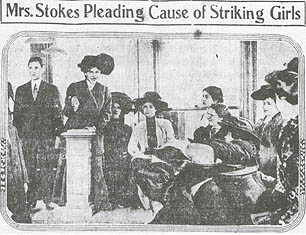
Rose Pastor Stokes - Notes
Rose Harriet Pastor Stokes (1879–1933)
Stokes was a leading member of the Socialist Party; sentenced to prison along with Eugene Debs for antiwar activities during WWI; a founding member of the American Communist Party and served for a number of years as an elected member of its executive committee; went to Moscow in 1922 along with John Reed as an American delegate to the Fourth Congress of the Comintern; and participated in the Comintern’s special Negro Commission.
Oh yeah, and she also wrote proletarian plays and poetry. “In 1916, she wrote ‘The Women Who Wouldn’t’ which was a play about the rise of a woman labor leader. Rose also contributed numerous poems and articles to such publications as The Masses, Independent, and Century.”
http://dlib.nyu.edu/findingaids/html/tamwag/tam_053/bioghist.html
http://drs.library.yale.edu/HLTransformer/HLTransServlet?stylename=yul.ead2002.xhtml.xsl&pid=mssa:ms.0573&clear-stylesheet-cache=yes
http://en.wikipedia.org/wiki/Rose_Pastor_Stokes
http://socialismartnature.tumblr.com/post/73408920710/rose-harriet-pastor-stokes-1879-1933-so-little
http://jwa.org/encyclopedia/article/stokes-rose-pastor
http://spartacus-educational.com/USAWstokes.htm
http://www.webcitation.org/5ko4fW1XV
http://www.marxists.org/subject/women/authors/stokes/index.htm
ProQuest search
MIA search
http://www.marxists.org/history/usa/parties/spusa/1918/0119-engdahl-onstokes.pdf
http://books.google.com/books?id=LxlmQgAACAAJ
http://books.google.com/books?id=KopInwEACAAJ
https://archive.org/details/ldpd_5654980_000



Tuesday, September 17, 2013

Friday, June 14, 2013
Review of "Lucy Parsons: An American Revolutionary"
This review first appeared in the May-June 2013 issue of the International Socialist Review.
===
 http://www.haymarketbooks.org/pb/Lucy-Parsons
Carolyn Ashbaugh
Lucy Parsons: An American Revolutionary
Haymarket Books, 2013 • 282 pages • $16
Review by Keith Rosenthal
With the republication of this long out-of-print 1976 work by Carolyn Asbaugh, Haymarket Books has provided a major boon for a new generation of radical and progressive activists. Lucy Parsons might very well be the most unsung of heroes among the pantheon of major American labor revolutionaries, such as Eugene Debs, William "Big Bill" Haywood, and Mother Jones.
As Ashbaugh informs us, Parsons was one of the first women to join the Knights of Labor in 1879 and the first woman of color to rise to prominence in the revolutionary left. She helped found the International Working People's Association, the U.S. Socialist Party, the Industrial Workers of the World (IWW), and lent her efforts to the development of the U.S. Communist Party (CP). She also figured prominently in the events surrounding one of the most notorious episodes in the history of the American labor movement: the 1886-7 frame-up, trial, and execution of the Haymarket Martyrs, whose numbers included her husband, Albert Parsons.
Additionally, Parsons was one of the very first to seriously address the question of racism and the plight of Black people at the turn of the century in the pages of the socialist and anarchist press. And she was a pioneering advocate for women's rights, including unfettered access to abortion and birth control, the right to at-will divorce, to be free from rape -- marital and otherwise, and she organized domestic laborers and housewives into Working Women's Unions.
===

Carolyn Ashbaugh
Lucy Parsons: An American Revolutionary
Haymarket Books, 2013 • 282 pages • $16
Review by Keith Rosenthal
With the republication of this long out-of-print 1976 work by Carolyn Asbaugh, Haymarket Books has provided a major boon for a new generation of radical and progressive activists. Lucy Parsons might very well be the most unsung of heroes among the pantheon of major American labor revolutionaries, such as Eugene Debs, William "Big Bill" Haywood, and Mother Jones.
As Ashbaugh informs us, Parsons was one of the first women to join the Knights of Labor in 1879 and the first woman of color to rise to prominence in the revolutionary left. She helped found the International Working People's Association, the U.S. Socialist Party, the Industrial Workers of the World (IWW), and lent her efforts to the development of the U.S. Communist Party (CP). She also figured prominently in the events surrounding one of the most notorious episodes in the history of the American labor movement: the 1886-7 frame-up, trial, and execution of the Haymarket Martyrs, whose numbers included her husband, Albert Parsons.
Additionally, Parsons was one of the very first to seriously address the question of racism and the plight of Black people at the turn of the century in the pages of the socialist and anarchist press. And she was a pioneering advocate for women's rights, including unfettered access to abortion and birth control, the right to at-will divorce, to be free from rape -- marital and otherwise, and she organized domestic laborers and housewives into Working Women's Unions.
Thursday, September 20, 2012
Notes on Lenin, the Russian civil war, red terror, "The Black Book," and prostitution (literal & figurative)
http://en.wikipedia.org/wiki/War_communism
- [Makes mention that part of War Communism was that "strikers could be shot," which itself is a quite ambiguous statement. The citation for this is: Nicolas Werth, "Histoire de l'Union Soviétique de Lénine à Staline," 1995. Co-author of Black Book of Communism (see below). It's not exactly clear what this is in reference to or what exactly this is based on ... ]
- After reading Werth's "Histoire," I could find absolutely no mention of strikers being shot. It certainly covers a lot of other people being shot by the Cheka during the civil war (i.e., Whites, SRs, kulaks, etc, i.e., the enemy forces). But the only thing I could find that even comes close to this in the book was the following sentence, which appears in a section dealing with the repression of War Communism: "The unions, many of which were not obedient to the Bolsheviks (railway, postal workers, typographers, employees, etc.), were either dissolved or reduced to the role of a 'transmission belt.'" (Presses Universitaires de France, 1995, p. 20)
- Leaving aside the question of the veracity of this statement there is certainly a world of difference between the supposed dissolution of unions hostile to the Bolsheviks and/or Soviet government, on the one hand, and a policy of shooting workers who go on strike, on the other.
http://en.wikipedia.org/wiki/Left-wing_uprisings_against_the_Bolsheviks#Repression
The Black Book of Communism: ""It is quite clear that preparations are being made for a White Guard uprising in Nizhni Novgorod," wrote Lenin in a telegram on 9 August 1918 to the president of the Executive Committee of the Nizhni Novgorod soviet, in response to a report about peasant protests against requisitioning. "Your first response must be to establish a dictatorial troika (i.e., you, Markin, and one other person) and introduce mass terror, shooting or deporting the hundreds of prostitutes who are causing all the soldiers to drink, all the ex-officers, etc. There is not a moment to lose; you must act resolutely, with massive reprisals. Immediate execution for anyone caught in possession of a firearm. Massive deportations of Mensheviks and other suspect elements." [http://www.marxists.org/archive/lenin/works/1918/aug/09gff.htm]
http://www.fas.harvard.edu/~hpcws/asreview.htm
"The Black Book of Communism sets out to address: the inability and -- for a great many -- the outright refusal to recognize the unmitigated evil that communism was and is ... [it proffers an] editorial outlook which asserts that Communism, in all its historical forms, is morally equivalent to Nazism ... The clearest picture to emerge from these pages is that the history of Communism is, at its simplest, little more than the history of an all-out assault on society by a series of conspiratorial cliques. These groups have, invariably, been led by excruciatingly cruel dictators who were revoltingly drunk on their own foolish ideology and power."
- [Published by Harvard University Press, written by career anti-communist hacks and apologists for capitalism; largely influenced by work of FA Hayek - conservative economist, connected with Milton and 'Chicago School,' virulent anti-communist, yet admirer of Pinochet, even taking honorary position in Pinochet government.]
Tuesday, May 1, 2012
Marxism, feminism, and accusations of "class reductionism"
I recently engaged in a friendly debate with someone who was arguing that Marxism is antithetical to the contemporary struggle for women’s rights because Marx was a “class reductionist” who ignored women’s oppression as something to be dealt with “after the revolution.”
I felt I would reproduce a snippet of my comments here:
===
I just wanted to say a quick word as someone who identities as both a Marxist and a feminist.
 In fact, Marx and Engels were well ahead of their time, viz., the stuggle for women’s emancipation. Even a terse reading of some of Marx’s collected works reveal him repeatedly inveighing against women’s oppression, both in society generally, and within the labor and socialist movements. Marx fought to have women included as full and equal members — including in leadership positions — in the various movements he engaged in as against many of his (bigoted) contemporaries.
He wrote that their could be no truly revolutionary movement without mass participation of women; indeed, he makes a point of saying that one can judge the level of development of any society by looking at the degree to which women have won their social emancipation in that society.
His collaborators, Frederick Engels and August Bebel, were among the first anti-capitalists to pen books specifically analyzing the history of women’s oppression. Along with Marx, they contend that a fundamental socio-economic revolution is impossible unless premised upon the complete liberation of the female half of the population (both from class exploitation and gender oppression).
Some of the first American feminists, including Margaret Sanger (the founder of Planned Parenthood), Helen Keller, and Lucy Parsons, were themselves members of the American Socialist Party, and they all cite the works of Marx & Engels as a central contributor to the development of their understanding of women’s oppression and liberation.
In sum, I think it’s wrong to say that Marxism is “class reductionist” or ignores the question of women’s rights as something to be dealt with “after the revolution.” Certainly there have been those who have historically claimed the label “Marxist” who have been guilty of such distortions. But then again, the terms “feminism”, “democracy”, and even “human rights” have also been historically subject to distortions by many of their supposed proponents. Just as we need to struggle against those who have tried to turn “feminism” into a dirty word, I personally think the same is true of “Marxism.”
I felt I would reproduce a snippet of my comments here:
===
I just wanted to say a quick word as someone who identities as both a Marxist and a feminist.
In fact, Marx and Engels were well ahead of their time, viz., the stuggle for women’s emancipation. Even a terse reading of some of Marx’s collected works reveal him repeatedly inveighing against women’s oppression, both in society generally, and within the labor and socialist movements. Marx fought to have women included as full and equal members — including in leadership positions — in the various movements he engaged in as against many of his (bigoted) contemporaries.He wrote that their could be no truly revolutionary movement without mass participation of women; indeed, he makes a point of saying that one can judge the level of development of any society by looking at the degree to which women have won their social emancipation in that society.
His collaborators, Frederick Engels and August Bebel, were among the first anti-capitalists to pen books specifically analyzing the history of women’s oppression. Along with Marx, they contend that a fundamental socio-economic revolution is impossible unless premised upon the complete liberation of the female half of the population (both from class exploitation and gender oppression).
Some of the first American feminists, including Margaret Sanger (the founder of Planned Parenthood), Helen Keller, and Lucy Parsons, were themselves members of the American Socialist Party, and they all cite the works of Marx & Engels as a central contributor to the development of their understanding of women’s oppression and liberation.
In sum, I think it’s wrong to say that Marxism is “class reductionist” or ignores the question of women’s rights as something to be dealt with “after the revolution.” Certainly there have been those who have historically claimed the label “Marxist” who have been guilty of such distortions. But then again, the terms “feminism”, “democracy”, and even “human rights” have also been historically subject to distortions by many of their supposed proponents. Just as we need to struggle against those who have tried to turn “feminism” into a dirty word, I personally think the same is true of “Marxism.”
Sunday, January 29, 2012
Thursday, July 15, 2010
Resources, links, and facts regarding Marx/Engels & accusations of racism, sexism, anti-semitism, etc.
Marx on US slavery/civil war (racism):
http://www.marxists.org/archive/marx/works/1861/10/25.htm
http://www.marxists.org/archive/marx/works/1861/12/14.htm
http://www.marxists.org/archive/marx/works/1862/02/02.htm
http://www.marxists.org/archive/marx/works/1862/05/22.htm
http://www.marxists.org/archive/marx/works/1862/06/20.htm
http://www.marxists.org/archive/marx/works/1862/08/09.htm
http://www.marxists.org/archive/marx/works/1862/11/10.htm
http://www.marxists.org/archive/marx/iwma/documents/1865/to-americans.htm
http://www2.cddc.vt.edu/marxists/archive/marx/works/1862/letters/62_11_17.htm
http://www2.cddc.vt.edu/marxists/archive/marx/works/1862/letters/62_07_30.htm
http://www2.cddc.vt.edu/marxists/archive/marx/works/1862/letters/62_10_29.htm
http://www.marxists.org/archive/marx/iwma/documents/1864/lincoln-letter.htm
Marx & racism ('n-word', etc):
http://www.google.com/search?as_sitesearch=www.marxists.org%2Farchive%2Fmarx%2F&hl=en&ie=8859-1&oe=8859-1&as_occt=any&num=30&btnG=Google+Search!&as_epq=nigger&as_occt=all&as_q=&as_oq=&as_eq=
(lassalle) http://www2.cddc.vt.edu/marxists/archive/marx/works/1862/letters/62_04_28.htm
http://joanofmark.blogspot.com/p/karl-marx-racist.html
Use of 'n-word' in 1860s (douglass, tubman, truth, etc):
http://findarticles.com/p/articles/mi_m2838/is_4_37/ai_n6075274/pg_8/?tag=content;col1
http://utc.iath.virginia.edu/minstrel/miar03bt.html
http://www.yale.edu/glc/soskis/fr-5.htm
http://www.spartacus.schoolnet.co.uk/USASoverseers.htm
http://docsouth.unc.edu/neh/bradford/summary.html
http://learningtogive.org/lessons/unit133/lesson2_attachments/1.html
Contemporary racists (rhodes, johnson, etc):
http://thinkexist.com/quotation/we_must_find_new_lands_from_which_we_can_easily/343653.html
http://www.independent.co.uk/news/world/africa/cecil-rhodes-a-bad-man-in-africa-654195.html
http://www.nas.com/~lopresti/ps17.htm
xroads.virginia.edu/~cap/scartoons/car1860.html
www.perno.com/amer/docs/Defense%20of%20Slavery%20As%20a%20Benefit%20to%20Society.htm
Marx & anti-semitism
www.engageonline.org.uk/journal/index.php?journal_id=10&article_id=33
http://www.wsws.org/articles/2002/may2002/corr-m29.shtml
http://www.marxists.de/religion/draper/marxjewq.htm
http://www.isj.org.uk/index.php4?id=460&issue=119
http://www.marxists.de/religion/leon/
Marx & women's oppression
http://www.marxists.org/archive/marx/works/subject/women/index.htm
http://www.marxists.org/archive/draper/1970/07/women.htm
http://links.org.au/node/934
http://www.newworldencyclopedia.org/entry/Paris_Commune
http://www.marxists.de/gender/cliff/03-commune.htm
http://en.wikipedia.org/wiki/Elisabeth_Dmitrieff
http://marxists.org/archive/marx/works/1868/letters/68_12_05.htm
http://www.marxists.org/archive/marx/works/1885/letters/85_07_05.htm
http://www.marxists.org/archive/marx/works/1868/letters/68_12_12.htm
http://www.marxists.org/archive/marx/works/1889/letters/89_11_20.htm
http://www.marxists.org/archive/marx/works/1889/letters/89_12_07.htm
Engels on native americans:
http://www.marxists.org/archive/marx/works/1839/letters/39_01_20.htm
Proudhon:
http://www.marxists.org/archive/draper/1966/twosouls/4-anarch.htm
Subscribe to:
Posts (Atom)