Showing posts with label communism. Show all posts

Monday, May 16, 2022

Review of "Woody Guthrie: An Intimate Life" | Disability Studies Quarterly

Originally published at Disability Studies Community Blog

Woody Guthrie: An Intimate Life
Gustavus Stadler
Beacon Press, 2020

Image of book cover featuring title and profile of Woody Guthrie
Woody Guthrie: An Intimate Life is an eponymous man-behind-the-myth look at an abiding figure of folk-music and left-wing Americana. Against the popular (and populist) conception of Guthrie as a rugged, rambling, and hardheaded archetype of freewheeling Old Left communist politics and salt-of-the-earth masculinity, author Gustavus Stadler presents a man whose life’s labors were informed by a profound awareness of vulnerability, fragility, and debilitation. An Intimate Life is also more than pure biography as it is an opportunity to explore the broader concepts of love, sexuality, disability, and communism in the context of the early-to-mid-twentieth century United States, as refracted by the personage of Guthrie. Though not a work of the Disability Studies genre, per se, the issues of normativity (and deviance), madness, impairment, and physiological stigma and shame are featured prominently throughout the book.

Indeed, this book is an intimate biography and a biography of the intimate. More than Guthrie’s strident politics or ideological journey, Stadler focuses on the private correspondences, diary writings, and personal friendships that reveal Guthrie as a deeply sensual human being. Rather than conjuring the image of a man violently strumming a guitar amidst the throes of revolutionary fervor, An Intimate Life elicits the sensation of a man delicately rolling a pencil between his fingers as he prepares to put innermost thoughts to paper. It is more Walt Whitman than Karl Marx, who is put into communion with Guthrie in this book. In describing the import of Guthrie’s semi-autobiographical novel, Bound for Glory, published in 1943, Stadler writes that it tells “the story of his [Guthrie’s] interest in troubled people and damaged bodies that needed intimate attention.” This includes scenes of “men improvising relations of care, of quasi-domesticity” while riding in train boxcars across the Midwest. It also significantly includes Guthrie’s “haunted” relationship with his mother, Nora, “through his deeply traumatized depiction of [her] decline,” due to Huntington’s disease.

Nora Guthrie began expressing increasingly acute symptoms of Huntington’s, viz. physiological and psychological loss of control, when Woody was still young. The people of the small Oklahoma town in which the Guthrie family lived began to comment derisively upon and shun Nora for being “crazy.” In 1927, Woody’s father had Nora committed to a state institution for the “insane,” where she died shortly thereafter. The young Woody, ignorant at the time of both the diagnosis and the heritability of Huntington’s disease, would have been shocked to know that a similar fate awaited him in his elder years. In fact, the adult Woody Guthrie of the 1950s was resistant to the Huntington’s diagnosis given to him by doctors; he instead attributed his advancing physiological and psychological impairments – and his increasingly frequent and extended stays in various state institutions and psychiatric hospitals around New York City – to alcoholism.

There are other often-overlooked elements of Guthrie’s story that Stadler gives extensive treatment to, such as the importance of his relationship with his long-time partner and wife, Marjorie Greenblatt Mazia; Guthrie’s fascination and complicated relationship with sex, sexuality, and homosexuality; and the abstract artistic expressionism of his later years, after he began exhibiting symptoms of Huntington’s, which focused on questions of racism, whiteness, and white supremacy in the U.S. Additionally, Stadler presents an even-handed, if not sympathetic, interpretation of Guthrie’s lifelong commitment to working-class revolutionary politics and the American communist movement, which enjoyed something of a surge in popularity in the New Deal 1930s.

From a disability and madness studies vantage the most interesting sections of An Intimate Life are to be found in the latter chapters of the book, which examine Guthrie’s experience with and reflections upon being institutionalized. Between 1956 and 1967, when he died at the age of fifty-five, Guthrie cycled between a number of state institutions, sometimes voluntarily and sometimes involuntarily. The conversations and observations he obtained from others in these institutions profoundly impacted him. ‘Shell-shocked’ war veterans, old leftists, ‘deviant’ victims of the 1950s persecution of homosexuality – such people furthered Guthrie’s awareness of the social effects of stigma, marginalization, and shame. Mediated by a callous and cruel capitalist social system and an imperious medical establishment, Guthrie saw in his fellow ‘patients’ not people who were primarily victims of their various diagnosed pathologies – many of whom Guthrie maintained were “sick in [their] own healthy [emphasis added] way” – but victims of a “crazy mixed up” society.

In a fascinating stroke of comparative insight, Stadler contextualizes Guthrie’s experience by making recourse to the apt poetry of Allen Ginsberg. In 1956, the same year that Guthrie entered the Greystone Psychiatric Hospital near New York City, Ginsberg published the famous poem, “Howl,” which references Greystone and other New York institutions, inhabited by “twenty-five thousand mad comrades.” When Ginsberg writes in the opening line of the poem, “I saw the best minds of my generation destroyed by madness,” he may well have had numerous specific names in mind, as Ginsberg witnessed many friends, contemporaries, and family members committed to institutions over the years, many of whom identified as communist, queer, or otherwise non-normative.

An Intimate Life has a lot to offer those interested in a diverse array of subjects. It is a story of the shifting ideological climate of the United States between the 1900s and 1950s, as working-class politics went from milieux of itinerant syndicalist organizing, to New Deal and Popular Front socialism, to revanchist and repressive Cold War anti-communism. It is a story of sexual politics, gender variance, and the socially-constructed deviance corresponding thereto. It is a story of American racism, lynch mobs, white supremacy, and critical self-reflective whiteness. It is a story of disability, illness, normativity, stigma, and institutionalization. And it is a story of love, romanticism, the beauty and bane of family intimacy, poetry, music, the sublime, and the sublimated.

Saturday, April 10, 2021

Helen Keller's Socialism: Review of 'Her Socialist Smile' | New Politics

Originally published in New Politics Vol. XVIII No. 2, Whole Number 70 (Winter 2021)

Her Socialist Smile
By: John Gianvito
Traveling Light, 2020.

“The seeds of socialism are being scattered far and wide, and the power does not exist in the world which can prevent their germination.”

—Helen Keller

“There is a pertinence and connection between [Helen’s politics and] our current historical moment (even one hundred years later). She has a lot of things to say to us. … She had belief in the power of the young to move us a few steps closer to the kind of world we’d like to live in. So I hope this film speaks to new generations of activists and gives them some nutrition for the good fight.”

—John Gianvito, Q & A with the director, Her Socialist Smile (2020)

A director would normally balk at the prospect of making a movie about an historical subject on whom there is an extreme dearth of extant audio or visual material. In fact, director John Gianvito did precisely that twenty years ago when he first began exploring the possibility of making a movie on the under-appreciated socialist politics of Helen Keller. Gianvito had originally discovered Keller’s radical political history within the writings of the influential “people’s historian,” Howard Zinn, about whom Gianvito would later make an award-winning documentary (Profit Motive and the Whispering Mind, 2007).

Unfortunately for Gianvito, the primary medium by which Keller (who was blind and deaf) communicated her voluminous thoughts was, of course, that of the written rather than aural or visual word. Additionally, much of Keller’s personal archive of photographic and recorded content was destroyed over the years in a series of tragedies (a house fire in 1946 and the destruction of the World Trade Center in 2001).

Recently, however, Gianvito decided to revisit the project. The renewed popularity of socialist ideas following the 2008 global crisis of financial capitalism, the rise of the Occupy Wall Street and Black Lives Matter movements, the historic campaigns of Bernie Sanders within the Democratic Party primaries, and the meteoric growth of Democratic Socialists of America—all these signs pointed to a revivified relevance of socialism in the United States.

In this light, Gianvito adopted a different conception of the Keller vehicle. The scarcity of primary audio and visual source material was inescapable, Gianvito recognized; but perhaps this was quite metaphorically fitting for a subject who made use of neither the sense of sight nor sound.

The resultant, imaginative oeuvre is the documentary Her Socialist Smile (2020), which recently received a limited run through the 58th New York Film Festival (held entirely online this year due to the ongoing coronavirus pandemic). The 1 hour, 33 minute movie is an interesting bricolage of white text against a black background; an eclectic selection of thematic music; scenes of nature in states of change and at rest; topical clips from newsreel and other secondary historical sources; professional narration and voice acting performed by Carolyn Forché; and the rare gem offering firsthand recordings and photographs of Keller speaking, writing, working, and playing.

All of this makes the documentary appear as an unlikely combination of worlds. With its text-on-screen format overlaid by musical and narrative accompaniment, one experiences the anachronistic universe of silent film; its interspersed shots of icicles melting in springtime or a slug making a herculean pilgrimage across the face of a boulder strike one as eminently modernist in form.

This latter aspect of the movie may not be quite so eagerly met by those whose primary attraction to the title stems from a desire to learn more about Keller’s socialist thought. There are odd stretches of long minutes in which on-screen bees pollinate flowers and flies buzz around an animal carcass. There is also an odd exception to form when the viewer is presented with the lone instance of political analysis, not by an interviewee discussing Keller’s politics, the various U.S. social movements of which she was a part, or the complexities of disability political theory in Keller’s time and now. Rather, the movie is given over to a four-minute clip of Noam Chomsky speaking at an event in 1989 on the ideological repercussions of the Cold War and the differences between the “opportunistic … Leninism” of the 1917 Bolshevik “coup” in Russia (an event which Keller, incidentally, viewed as a revolutionary beacon of socialist hope to the world) and the “mainstream Marxist movement” represented by the German Social-Democratic Party and the likes of Anton Pannekoek.

However, leaving aside questions of appropriate analyses of the social nature of Russia over the seventy-plus years between workers’ revolution and “the fall of Communism,” the central political content of Her Socialist Smile is both inspiring and edifying. Keller lived during the tumultuous years spanning 1880 to 1968; she identified as a socialist for sixty of those years, and was heavily involved in all of the major socialist and radical movements and organizations in the United States for roughly fifteen of those years, beginning in 1908 when she joined the Socialist Party.

Throughout this period she participated in protests for women’s equality and Black freedom. She organized in solidarity with workers strikes and anti-imperialist initiatives. She toured and gave speeches on behalf of the Socialist Party of America and the Industrial Workers of the World. She offered her prestige to movements affiliated with the American Communist Party. She supported the struggle against nuclear weapons and the anti-communism of Cold War McCarthyism. She wrote prolifically on the topic of social revolution, workers’ power, socialist strategy, the injuries of economic inequality, the violence and opposition to democracy of the capitalist class, the oppression of the disabled and the economically marginalized, and the hope of a society reimagined around the principle that “the welfare of each is bound up with the welfare of all.”

Gianvito provides us with a taste of this all—a taste of Keller’s political genius. There are certainly elements of the documentary that are wanting. For instance, Gianvito inexplicably leaves out any discussion of Keller’s association with the anti-colonial movements of the 1940s and 1950s; the concomitant Non-Aligned Movement, whose leading figures, such as Jawaharlal Nehru and Josip Tito, drew the keen interest of Keller; or the affection with which Keller regarded Henry Wallace’s 1948 Progressive Party campaign for U.S. president. Further, Gianvito’s documentary does not include any analysis of the politics of disability, which were of course integral to Keller’s lifework.

Nonetheless, Her Socialist Smile is a welcome contribution to the contemporary proliferation of socialist-educational materials. If the movie does nothing more than whet the audience’s appetite for more of Keller’s politics, and socialism in general, then it can be considered a great success.

Monday, March 30, 2015

Socialism & Disability: The politics of Helen Keller

By Keith Rosenthal

This article was originally published at International Socialist Review.

Helen Keller is one of the most widely recognized figures in US history that people actually know very little about. That she was a serious political thinker who made important contributions in the fields of socialist theory and practice, or that she was a pioneer in pointing the way toward a Marxist understanding of disability oppression and liberation—this reality has been overlooked and censored. The mythological Helen Keller that we are familiar with has aptly been described as a sort of “plaster saint;” a hollow, empty vessel who is little more than an apolitical symbol for perseverance and personal triumph.1

This is the story that most of us are familiar with: A young Helen Keller contracted an illness that left her blind and deaf; she immediately reverted to the state of a wild animal, as depicted in the popular movie The Miracle Worker; she remained in this state virtually unchanged until she was rescued by her teacher Anne Sullivan, who “miraculously” introduced her to the world of language. Then time passed, and Helen Keller died eighty years later: End of story.

The image of Helen Keller as a gilded, eternal child is reinforced at the highest levels of US society. The statue of Helen Keller erected inside the US Capitol building in 2009, which replaced that of a Confederate Army officer, depicts Keller as a seven-year-old child kneeling at a water pump. Neither the statue itself nor its inscription provides any inkling that the sixty-plus years of Keller’s adult life were of any particular political import.

When the story of Helen Keller is taught in schools today, it is frequently used to convey a number of anodyne “moral lessons” or messages: There is no personal obstacle that cannot be overcome through pluck and hard work; whatever problems one thinks they have pale in comparison to those of Helen Keller; and perhaps the most insidious of such messages, the one aimed primarily at people with disabilities themselves, is that the task of becoming a full member of society rests upon one’s individual efforts to overcome a given impairment and has nothing to do with structural oppression or inequality.

Ironically, this construction of the iconic, or mythological, Helen Keller has resulted in numerous essays and books written by individuals with disabilities who recount growing up feeling deeply resentful of her. They saw Keller as an impossibly perfect individual who personally overcame all limitations in order to become a world-famous figure—someone who pulled herself up by her bootstraps, so to speak, and did so with a polite smile.2 In reality, such a narrative starkly contradicts the experiences of the vast majority of people with disabilities, then and now, who endure incredibly high rates of poverty, homelessness, discrimination, police brutality, and ostracism.

Distortions of Helen Keller, then and now

Keller fought her entire life against such bigoted notions and distortions of her life story. She constantly combated attempts to render her a hollow icon. Nonetheless, such images regarding Keller and disability continue to be reinforced everywhere. This can be found in primary school curricula, in the vast majority of children’s books on Helen Keller, and in most adult biographies of her. More often than not her radical politics are simply ignored. But even when they are acknowledged, it is usually to discount them.

One of the most authoritative recent biographies on Keller—written by the noted author Joseph Lash, and commissioned by the prestigious Radcliffe College and the American Foundation for the Blind—includes the following explanation of Keller’s involvement with socialist politics: “She needed to see the world as a contest between Good and Evil. Her imagination—cut off by blindness and deafness from many of the signals that brute experience sends most of us counseling caution, compromise, grayness instead of black and white—lent itself to dichotomies. . . . If she kept some grip on reality, it was because of her Teacher [Anne Sullivan], a woman of practical common sense.”3

This assessment, while expressed in milder terms, isn’t far from the accusations Keller regularly faced in her lifetime. Newspaper editors would use her disability as a means to dismiss her politics and to dissuade people from taking her seriously. Her radicalism, conservative writers would aver, was a product of the political “mistakes [which] spring out of the manifest limitations of her development.”4

Here is what the Detroit Free Press wrote about her in 1914:

As long as Miss Keller appears before the public in the light of a member of society struggling nobly under great handicaps and furnishing by her example inspiration for others who are unfortunately placed, she does a valuable work. But the moment she undertakes to speak ex cathedra, as it were, of all the political and social problems of the day, she receives a consideration out of all proportion to her fund of knowledge and judgment.

Helen Keller, struggling to point the way to the light for the deaf, dumb and blind is inspiring. Helen Keller preaching socialism; Helen Keller passing on the merits of the copper strike; Helen Keller sneering at the constitution of the United States; Helen Keller under these aspects is pitiful. She is beyond her depth. She speaks with the handicap of limitation which no amount of determination or science can overcome. Her knowledge is, and must be, almost purely theoretical, and unfortunately this world and its problems are both very practical.5

What is remarkable, however, is the power and tenacity Keller brought to bear in answering these attacks. She courageously defied any and all attempts to render her a second-class citizen. She would have her say, and woe unto those who would try to silence her.

The radicalization of Helen Keller

Helen Keller was born in 1880 in Alabama to an upper-class family. Her father had been a slave-owner before the Civil War in which he had served as a commanding Confederate officer. After the war, he became the editor of a major newspaper in Alabama. Keller’s mother hailed from a wealthy and connected New England family.

When Helen Keller was two years old she became permanently deaf and blind as the result of an unknown illness. It was not until she was seven years old that she began her formal education under Anne Sullivan, a twenty-one-year-old graduate of the Perkins School for the Blind, who had been hired by the Kellers as a live-in tutor.

Keller’s education proceeded rapidly under Sullivan’s guidance, and her development soon gained attention from increasingly far-flung quarters. When she enrolled in a college preparatory school with seeing and hearing girls in 1896, newspapers around the country—and even the world—ran articles detailing her course loads, semester grades, and attendance records. Her every move became the subject of intense scrutiny and gossip. By the time she had graduated with a Bachelor of Arts degree from Radcliffe College in 1904, Keller had become something of a global celebrity.

Then, in 1908, Helen Keller took the seemingly unlikely step of joining the American Socialist Party (SP). She cites two major factors that led her to this: First, her widespread readings on society and philosophy, which had ultimately led her to the works of Karl Marx as well as those of contemporary socialists, such as H. G. Wells, William Morris, and Eugene Debs; and second, her growing interest in studying the specific conditions of people with disabilities in the United States, which led her to draw conclusions about society that dovetailed with the former.

She noticed that the leading causes of disability in the United States were largely attributable to industrial and workplace accidents and diseases, frequently caused by an employer’s greed and reluctance to prioritize workers’ safety lest it diminish profits. She found that other social factors contributed, too, such as the prevalence of poverty, unequal access to medicine, overcrowded and unsanitary slums, and an officially imposed societal ignorance regarding matters of reproductive and sexual health.

She discovered that, once disabled, such individuals constituted a class who “as a rule are poor,” cast aside and forgotten.6 They were thrown into institutions; mired in poverty and unemployment; cut off from educational opportunities; and segregated and marginalized at every turn. There was not a single census in any state or city of the country that even kept track of the numbers and needs of the disabled population. They simply did not exist as far as the powers-that-be were concerned.

“Step by step,” Keller recounted in 1912, “my investigation of blindness led me into the industrial world.”

And what a world it is! How different from the world of my beliefs! I must face unflinchingly a world of facts—a world of misery, degradation, blindness, sin, a world struggling against the elements, against the unknown, against itself. How to reconcile this world of fact with the bright world of my own imagining? My darkness had been filled with the light of intelligence, and behold the outer day-lit world was stumbling and groping in social blindness.7

“For a time I was depressed,” she told the New York Times in 1916, “but little by little my confidence came back and I realized that the wonder is not that conditions are so bad, but that humanity has advanced so far in spite of them. And now I am in the fight to change things. I may be a dreamer, but dreamers are necessary to make facts!”8

In short, she had come to conclude that “our worst foes are ignorance, poverty, and the unconscious cruelty of our commercial society. These are the causes of blindness; these are the enemies which destroy the sight of children and workmen and undermine the health of mankind.”9

One final factor that attended her decision to publicly commit to the socialist movement is less explicitly political but nonetheless important. In 1908, she wrote a sort of existential treatise titled The World I Live In. Keller felt that if she were to be taken seriously by society at large in the assertion of her right as a human being to discuss the affairs of that society, she would have to mount a fundamental intellectual self-defense against her many detractors.

[Scientific men] think that I can know very little about objects even a few feet beyond the reach of my arms. Everything outside of myself, according to them, is a hazy blur. Trees, mountains, cities, the ocean, even the house I live in are but fairy fabrications, misty unrealities.

Ideas make the world we live in, and impressions furnish ideas. My world is built of touch-sensations, devoid of physical color and sound; but without color and sound it throbs with life. Every object is associated in my mind with tactual qualities which, combined in countless ways, give me a sense of power, of beauty, or of incongruity.

It is not for me to say whether we see best with the hand or the eye. I only know that the world I see with my fingers is alive, ruddy, and satisfying. . . . The colors that glorify my world, the blue of the sky, the green of the fields, may not correspond exactly with those you delight in; but they are none the less color to me. The sun does not shine for my physical eyes, nor does the lightning flash, nor do the trees turn green in the spring; but they have not therefore ceased to exist, any more than the landscape is annihilated when you turn your back on it.

In sum, she asserted, “Between my experience and the experience of others there is no gulf of mute space which I may not bridge.”10


Monday, September 22, 2014

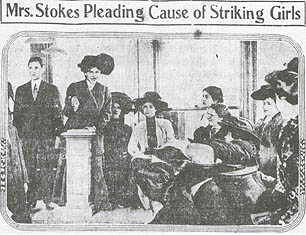
Rose Pastor Stokes - Notes

Rose Harriet Pastor Stokes (1879–1933)

Stokes was a leading member of the Socialist Party; sentenced to prison along with Eugene Debs for antiwar activities during WWI; a founding member of the American Communist Party and
served for a number of years as an elected member of its executive committee; went to Moscow in 1922 along with John Reed as an American delegate to the Fourth Congress of the Comintern; and participated in the Comintern’s special Negro Commission.

Oh yeah, and she also wrote proletarian plays and poetry. “In 1916, she wrote ‘The Women Who Wouldn’t’ which was a play about the rise of a woman labor leader. Rose also contributed numerous poems and articles to such publications as The Masses, Independent, and Century.”


http://dlib.nyu.edu/findingaids/html/tamwag/tam_053/bioghist.html
http://drs.library.yale.edu/HLTransformer/HLTransServlet?stylename=yul.ead2002.xhtml.xsl&pid=mssa:ms.0573&clear-stylesheet-cache=yes
http://en.wikipedia.org/wiki/Rose_Pastor_Stokes
http://socialismartnature.tumblr.com/post/73408920710/rose-harriet-pastor-stokes-1879-1933-so-little
http://jwa.org/encyclopedia/article/stokes-rose-pastor
http://spartacus-educational.com/USAWstokes.htm
http://www.webcitation.org/5ko4fW1XV
http://www.marxists.org/subject/women/authors/stokes/index.htm
ProQuest search
MIA search
http://www.marxists.org/history/usa/parties/spusa/1918/0119-engdahl-onstokes.pdf
http://books.google.com/books?id=LxlmQgAACAAJ
http://books.google.com/books?id=KopInwEACAAJ
https://archive.org/details/ldpd_5654980_000