by Keith Rosenthal and Brian Escobar
==
==
A newscast on SUR Peru Sunday showed residents of Lima at their windows clapping and thanking the masked sanitation workers loading bags of trash into a garbage truck. The screen read, “Coronavirus: Cleaning in Lima, Anonymous Heroes.” Residents knew whose labor they were counting on to stay safe from the pandemic and knew the risks the workers were taking.
With the coronavirus pandemic now spreading across the United States — and local and national government officials belatedly cobbling together a response — naked truths about contemporary American capitalism have been laid bare.
For one, the existing privatized, patchwork health care system in the United States relying on just-in-time supply chains is incompatible with the needs of a globally integrated, healthy society. It has also become painfully clear that we can no longer endure the lack of a comprehensive public welfare infrastructure in this country (e.g., universal paid sick leave, income assistance, etc.).
Other components of American capitalism that are being exposed are the class divide and the social relations which inform production and distribution. Usually obscured by exaltation of the rich and powerful of society, the shutdown of all “non-essential” services has rendered obvious the essentiality of a particular subgroup of the American population.
In just a short time, the stoppage of American business-as-usual is revealing that the nation fundamentally relies on this indispensable subgroup — or class — of people to carry out the work essential for society’s functioning. This class of people comprises those engaged in labor without which all other social, economic, and political activities would grind to a halt. Indeed, without the labor of these individuals, such emergency measures as social distancing, lockdowns, and widespread self-quarantining would be impossible to maintain.
Who is “Essential”?
The question of who counts as “essential” is proving to be ad hoc, inconsistent and contested. Multiple governmental bodies and private employers are treating different sets of workers as essential. Companies like GameStop instructed employees to tell any official who came to shut them down that they were essential workers (GameStop finally closed stores on March 21). Meanwhile, some Starbucks employees are petitioning the company to stop considering them essential so they can go home with paid leave. The concept also tends to reinforce the devaluation of domestic work, disproportionately done by women, despite it being necessary for society’s continuation.
From a working class standpoint, we can rightly observe that nurses, delivery drivers and grocery store workers are showing the world how essential their work is, whereas advertising execs and app developers can safely stay home without any real cost to ordinary people.
While the ‘frontline’ essential workers who remain on the job do not encompass the entire working class, they nonetheless clearly compose a core part of it. Though disproportionately underrepresented in the political bodies of government, undercompensated in their share of national income and wealth, and underprivileged in their access to the nation’s education, health, and social security resources, these workers — along with the rest of the working class — bear upon their shoulders the entire edifice of American society.
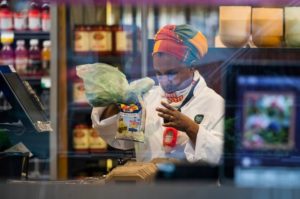
This section of the working class is made up of grocery store workers, food and delivery service workers, package and postal delivery workers, CVS and Walgreens workers, warehouse workers, sanitation workers, workers in the energy and telecom industries, farmworkers, childcare and personal care assistants, and of course emergency and medical service workers. This list is not exhaustive; but it starkly depicts the nature and scale of the labor which American capitalism rests upon, and even more so in times of crises.
Strip away the parasitical class of financial speculators and idle owners of corporate capital, the quasi-aristocratic families with immense dynastic wealth and power, the leisure class who can simply choose not to work and still live comfortably; strip away the pomp, circumstance, and chauvinism of the elites who comprise the ruling class of America, and you have lost nothing that is essential to the basic functioning of society.
Class Matters
What is the significance of pointing this out? First of all, it cuts through the veil of myth-making which has disguised the true nature of the world in which we live. Before the financial collapse of 2008 it was rare to hear a mainstream politician even mention the word “working class.” They spoke only of “saving the middle class” — a mantra which they repeated ad nauseam.
Sundry intellectuals and television news talking heads reinforced this paradigm, opining that even the notion of a working class was a Marxist anachronism in today’s postmodern American society. It was purported that the United States was a post-class technocracy, fluid and flat, and the populace was just one giant middle class sandwiched between two tiny and mildly bothersome populations of the very rich and the very poor. America was the suburbs and young urban professionals; the dishwashers and delivery drivers were a mere imaginary number in the equation.
Coronavirus is rattling the cage. As society “pauses” and relies on essential workers to get us through the crisis, we are forced to ask, for instance, why it is that those engaged in the basic, necessary work of our society are so often the most marginalized, maligned, underpaid, and disempowered?
Now we are beginning to hear grumbles from Wall Street and its political servants in government that the price — and they mean literal monetary price — of the current preventative economic standstill is simply too high. These corporate villains declare that they want all workers – “essential” or not — to return to work, regardless of the danger posed by the virus. They readily admit that ending social distancing will lead to countless unnecessary deaths. To the financial barons of the American stock exchange, a billion dollars in profit lost on the S&P 500 is far more important than a million human lives lost to an unflattened curve.
Essential Power
For now, it is the “essential” working class which remains on the front lines. The upshot, from the standpoint of class struggle, is that these workers now find themselves in a potentially pivotal position. With all of society resting upon their labors, the question is whether they will feel empowered by their newly visible importance and flex their collective muscles.
The alternative is that the humans who compose the ‘essential’ class will simply be ground down and sacrificed by the ruling class. This is being proven by the utter failure of bosses and governments to provide workers with adequate protective equipment, safety protocols, or hazard and sick pay
While the class itself and the labor it performs are indispensable to the functioning of society and to the profits of capitalists, the discrete human laborers, which the working class comprises, are deemed individually dispensable by the ruling class. Provided other human laborers are on the market and willing to take their place, the loss of a single set of hands is of no concern to the corporate owners. The work must go on, they insist, regardless of the cost in human lives. Thus, the only solution is for workers to collectively usurp control over the work itself.
Indeed, the mere threat of a strike or work slowdown on the part of essential workers at this moment could be sufficient to win major concessions from CEOs and governments. Across the country we’re already beginning to see ‘wildcat’ job actions and strikes planned by Amazon, city sanitation, and Instacart workers.
In short, the vulnerabilities of capitalism — both its abject failure to prepare for and contain the coronavirus, and its utter dependence on the labors of a class which it treats as little more than an expendable resource — means that it will be more possible than ever for America’s essential workers to fundamentally change the landscape of American class relations.
Witness the fact that some employers have already strategically offered certain limited concessions to workers, from one-time $300 cash bonuses ($100 for part-timers) to $1 an hour wage increases. Such scant boons, however, amount to a mere drop in the bucket when it comes to the cost of COVID-19 treatment.
Looking Deeper
Ultimately the crisis of the coronavirus, which is a crisis of capitalism from the virus’s origin to its spread, forces us to reflect upon the very way that work is organized throughout society.
Many people have taken to offering moving and heartfelt public commendations for the labor of essential workers amidst the crisis. Such praise is well earned for those who are soldiering on for the benefit of others despite hazardous conditions, like those Peruvian trash collectors. However, we would be remiss to ignore the insidious forms of economic intercourse that belie purely anodyne gestures of gratitude.
Labor in capitalist society is not a function of genuine free choice. Rather, the work people do is heavily determined by wealth, racial, gender, and other inequalities. Most Americans — perhaps apart from the middle and upper classes — don’t end up in the job they want in order to fulfill a dream, but the job they get in order to meet basic financial obligations; or, employers exploit their dreams to persuade them to work for little pay and grueling hours. That is, many workers in essential services industries enter or remain due to their financial vulnerability. It is not feasible for them to abruptly quit or stay home without pay; nor are they flush with access to a variety of different jobs.
Capitalism relies upon a form of coercion in which some humans are sufficiently more desperate than others so as to accept employment in hazardous conditions, for less pay, and with less job security. Especially in the absence of the basic protections afforded by unions, workers in essential sectors are often compelled to work entirely according to the whim and discretion of their employer.
There is a reason why wealthier people tend to avoid taking such essential jobs as sanitation work and grocery delivery. There is a reason why nurses tend to come from lower socioeconomic backgrounds than hospital executives, and why those who clean the hospitals tend to be disproportionately of a darker complexion than either of the above.
What would it mean to organize the work of society differently? Is it possible to have an equitable, democratically planned, and socially owned structure of work and consumption? The prevailing economic system is one in which the owners of capital hold despotic sway over the productive nodes of the economy. Consequently, they also hold ruling sway over all decisions about work and production: what gets produced, how the work is done, who the work is done by and for, and the manner in which the work is compensated.
When socialists call for a society based on workers’ power, it is in subversion of the above regime. The majority who do the work for society to function should have a ruling share in the decision-making power over the vital political, economic, and social questions of that society. Further, the economic and living conditions of the working class should be secure, elevated, and liberated to a degree that is inversely proportional to how insecure, depressed, and circumscribed they are at present.
Present conditions in the U.S. remain far removed from such a socialist vision. We have a long struggle ahead of us, not only to survive and navigate the immediate pandemic crisis, but also to fight to fundamentally remake society itself.
For the moment, many workers in low-paying and vulnerable jobs are receiving the recognition and respect that they have long deserved. We must never allow that recognition to be lost again and we must fight to turn recognition into power, and power into transformation.
Let us use this opportunity to push for everything that essential workers and all people need to live dignified and healthy lives in the twenty-first century: A twenty-five dollar minimum wage with full benefits; grocery chains converted into co-ops with safety and health protections regulated by the workers; the mass expansion of occupant-run, affordable public housing; transforming the largest banks into a national utility so as to stabilize people’s finances and fund general human needs; nationalization of hospitals, and the implementation of universal social services such as Medicare for All, Public Power, and internet access.
As the subheading of a recent New York Times op-ed asserted, “Everyone’s a socialist in a pandemic.” We know humanity can do better than this and that the welfare of each is dependent upon the welfare of all. We should proudly project this vision and use the “essentiality” of our class to win the lasting and necessary changes we deserve.